
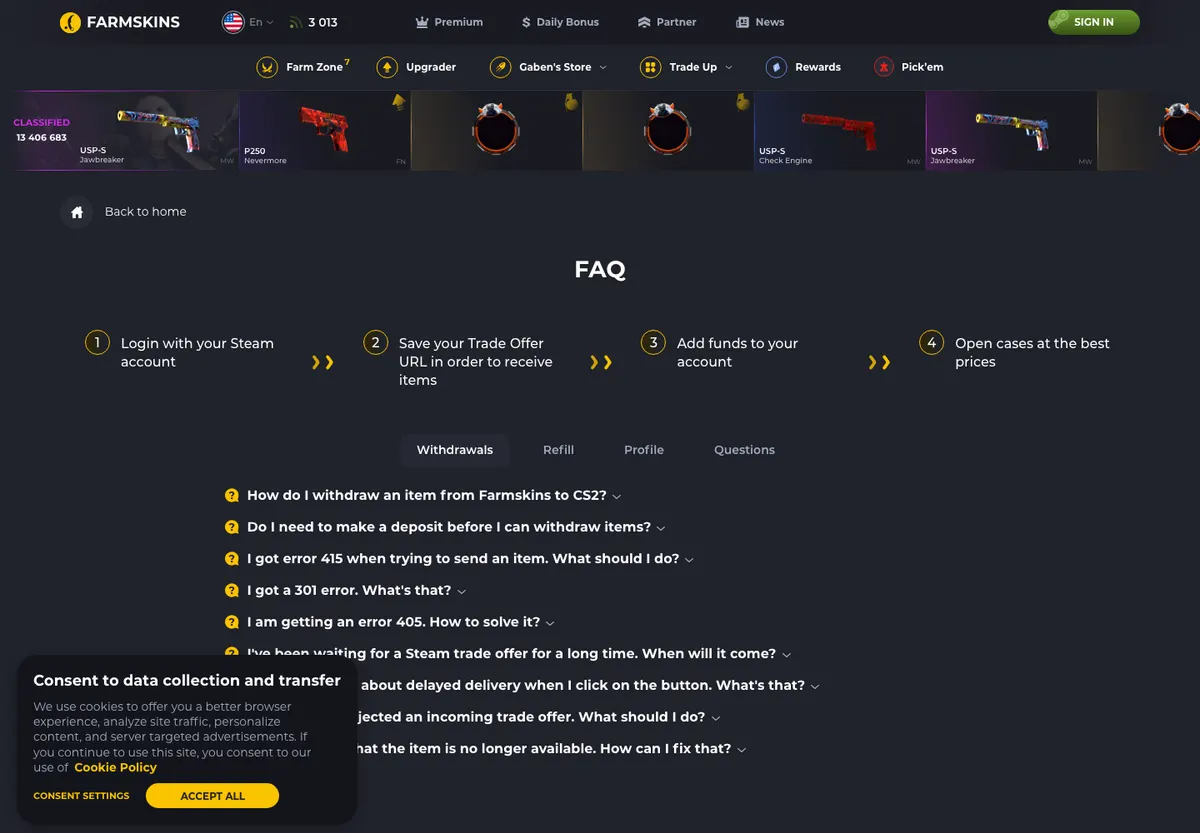
To verify a Farmskins case result yourself, you need more than an opening animation or an item history: you need a published calculation and the inputs used for that opening. Farmskins documents CS2 case opening, Farm Zone battles and an Upgrader, but its public FAQ, terms and homepage do not document a reproducible seed-and-hash verification procedure. The FAQ says an algorithm selects your item. Below, learn what that statement establishes, what a genuine verification workflow requires, and how to check any fairness evidence before spending.
Visit https://farmskins.com/faq to read the operator’s explanation alongside the verification checklist below.
Links to the official site are independent and earn no commission. →
Start with what Farmskins actually documents
Farmskins describes opening a virtual case and receiving an item from that case’s predefined loot table. That explains the product, but not how a particular outcome can be reproduced. An algorithm can select an item without exposing the evidence needed to audit that selection. The practical distinction is between being told that selection happens automatically and being able to calculate the result independently using information fixed before the opening.
The public FAQ, terms and homepage do not provide a documented combination of server seed, client seed, nonce, pre-opening commitment and result-mapping algorithm. Without those components, this guide cannot supply a working Farmskins-specific verifier. That is a limit on what you can independently establish from those descriptions, not proof that an individual result was manipulated. Keep that distinction in mind when comparing a fairness claim with the evidence behind it.
| Question | Documented position | What would establish more |
|---|---|---|
| How is a case item selected? | The FAQ says an algorithm picks an item; the terms describe a predefined loot table. | A published calculation linking recorded inputs to a particular item. |
| Can you check a seed commitment? | The public descriptions do not document a seed-and-hash workflow. | A commitment saved before play and a later matching seed disclosure. |
| Can you reproduce an opening? | No reproducible procedure is documented in those descriptions. | The exact inputs, algorithm, historical item mapping and expected output. |
| Does this prove an opening was unfair? | An undocumented verification process does not establish manipulation. | A specific, reproducible discrepancy would be stronger evidence than suspicion. |
Understand seeds, hashes and nonces before checking
The following explanation describes a general cryptographic commitment model, not Farmskins’ documented implementation. In such a model, the operator commits to secret information before an outcome is generated, then reveals enough information afterward for the user to reproduce the calculation. Different systems use different inputs and formatting rules. Knowing the vocabulary helps you ask useful questions, but it does not let you substitute a familiar method for an operator’s actual specification.
| Component | General purpose | What to check |
|---|---|---|
| Server seed | Secret input supplied by the operator and revealed later. | Whether its later disclosure matches the earlier commitment. |
| Server-seed hash | A cryptographic digest that commits to an input without displaying that input. | Whether it was available before the relevant outcome, rather than only afterward. |
| Client seed | User-side input included in schemes that support it. | Its exact value and when it was chosen or changed. |
| Nonce | A counter or identifier distinguishing calculations that reuse other inputs. | The value belonging to the specific opening, round or attempt. |
| Calculation specification | Rules for combining inputs and producing reproducible random material. | The function, input order, encoding and output-conversion rules. |
| Outcome mapping | Rules translating a generated value into an item or success condition. | The case, mode and probability table applicable at the time. |
A cryptographic hash is deterministic: applying the same function to exactly the same input gives the same digest. Secure hash functions are designed to make recovering the hidden input or finding a substitute with the same digest impractical. A hash is not the same thing as encryption, and you do not ordinarily decrypt it to reveal the seed. Instead, the seed is disclosed later and hashed again for comparison.
A long string of letters and digits is not automatically useful evidence. It must have a defined role in a documented process. A transaction identifier might look technical without being a commitment at all. Likewise, a nonce is not inherently proof of randomness: it distinguishes calculations, while the surrounding algorithm determines how those calculations work.
Follow the full commitment-to-result chain
The timing of disclosure matters as much as the mathematics. If a seed and its hash appear only after an outcome, they may agree perfectly without demonstrating that the seed was fixed beforehand. A useful commitment process connects a record saved before play with information revealed afterward. This general sequence shows what that evidence chain should let you inspect.
- A commitment exists before the openingThe operator displays a digest tied to its secret input. You retain that value before the relevant result is generated. The commitment should be associated with the correct seed period or event, so a later disclosure cannot simply be matched to an unrelated record.
- Any user-controlled input is fixedWhere a client seed is supported, its exact value becomes part of the record. The order matters: user input chosen after a genuine operator commitment serves a different purpose from input already known while the operator is selecting its secret. Follow the scheme’s stated timing rather than assuming it.
- The event receives its calculation identifierThe opening, round or attempt is associated with a nonce or another defined identifier. Do not assume every visible button press corresponds to the same kind of calculation. Batched openings and multi-round modes may require more detailed indexing under their own specifications.
- The result is generated under fixed rulesThe defined function combines the relevant inputs, and an outcome mapping translates the resulting value into an item or other result. Both stages matter. Reproducing a random value is incomplete if you cannot establish which loot-table interval or success condition that value selected.
- The secret is disclosed when appropriateIn many commitment schemes, the server seed becomes available after it is retired or rotated out. Revealing a still-active seed could expose future calculations, so an immediate disclosure is not always expected. What matters is a clear disclosure procedure linked to the earlier commitment.
- You reproduce the commitment and outcomeFirst check that the revealed input produces the saved commitment under the specified rules. Then recompute the event and apply its historical outcome mapping. Keep these checks separate: a matching commitment does not, by itself, demonstrate that the displayed item followed from the calculation.
How to verify a result yourself—if the inputs exist
There is no responsible shortcut from Farmskins’ statement that an algorithm chooses an item to a working independent calculation. The procedure below is conditional: use it only when an operator supplies an actual specification and the corresponding records. If a required component is unavailable, record that limitation rather than filling it with another site’s rules or a guessed formula.
- Save the event identifier, case name, selected mode and result exactly as displayed.
- Retain the commitment captured before the opening, not merely a later copy.
- Collect the client seed and nonce if the published scheme uses them.
- Obtain the revealed server seed through the documented disclosure process.
- Save the calculation specification and the item mapping applicable to that event.
- Keep original text exports where available; screenshots alone can truncate important strings.
- Check completeness before calculatingConfirm that every input refers to the same event. A server seed from a later rotation, a client seed changed after the opening or a nonce copied from a neighbouring record can produce a plausible-looking but irrelevant calculation. If the event association is unclear, resolve it before interpreting any mismatch.
- Recalculate the commitmentApply the published hashing rules to the revealed seed and any additional commitment inputs. Compare the output with your saved pre-opening digest. Respect the specified character encoding and formatting. Hidden spaces, line endings and treating text as encoded data rather than literal characters can change the result.
- Reproduce the random outputUse the precise function and input construction in the specification. Input order, separators and the way the nonce is represented can all matter. Do not assume that combining familiar fields in an intuitive order will reproduce the operator’s calculation, even when all the field values are correct.
- Apply the historical outcome mappingTranslate the computed output using the case and mode rules that applied to the event. Check interval boundaries, rounding and any documented handling of unusable output values. A current case page is not necessarily a record of the item pool or mapping used for an earlier opening.
- Record the conclusion narrowlyIf the commitment and mapped result both match, describe the particular event as reproducible under that specification. If they do not, preserve the original inputs and identify the first failing stage. Avoid turning a successful check into a claim about every event, or an unexplained mismatch into an accusation.
An operator-hosted verifier can make these steps easier, but it still runs in an environment controlled by the operator. Inspectable code or a separately implemented calculation gives you another way to compare results. Neither should require your Steam password, authenticator code or account access. A verifier should work from calculation inputs, not from permission to control your inventory.
Visit https://farmskins.com/ to inspect a case and its displayed rules before deciding whether to proceed.
Links to the official site are independent and earn no commission. →
Match the proof to the Farmskins mode
Even a valid random-output calculation does not explain an entire game automatically. The output must be connected to the correct rules. Farmskins documents several mechanics with different outcomes: a case selects an item, a battle compares results, and an upgrade targets a higher-value skin. A verification method for a simple opening should not be assumed to cover every additional decision in those modes.
| Mode | Documented mechanic | Additional verification question |
|---|---|---|
| Standard case opening | An item is selected from a predefined loot table. | Which output range selected that item under the applicable table? |
| Ultimate Mode | On some cases, the item pool may shrink and the price may drop. | Was the mapping for the selected mode used rather than the standard pool? |
| Farm Zone | Users open identical cases and compete for the resulting items. | Can each result and the applicable winner-calculation rule be reconstructed? |
| Upgrader | Input items and optionally Bullets are exchanged for a higher-value target; failure still yields a skin of unguaranteed value. | Can the target outcome and any failure-item selection be checked separately? |
Farm Zone particularly benefits from reading the applicable rules closely. The terms describe the highest total platform-valued result winning the items, while the Farm Zone page describes winners at round level. Those descriptions should not be silently treated as interchangeable. Establish the rule governing the match you are inspecting, including how values are compared. Reproducing the dropped skins would not by itself resolve uncertainty about how a match winner is determined.
For an Upgrader attempt, keep the target and the selected inputs in the record. A statement that a failed attempt still returns a skin does not explain its selection calculation or establish its value. For broader mode explanations, see Farmskins game modes. For the relationship between a case’s item pool and its opening process, use the Farmskins cases guide.
Troubleshoot a missing or mismatched verification
You have a result ID, but no seeds
Treat the identifier as a way to locate the event, not as proof of the selection process. Ask whether it links to a commitment, calculation inputs and a published algorithm. If the response only repeats the item name or confirms that an opening occurred, it has supplied an activity record rather than a reproducible fairness record. Keep the distinction clear in any follow-up: you are asking how the result was derived, not whether it appears in your history.
The revealed seed does not match the saved hash
Check whether you saved the commitment for the correct seed period and whether the specified commitment contains anything besides the server seed. Then inspect copying and encoding errors. Preserve the original strings before attempting corrections, so you do not accidentally replace evidence with a cleaned-up version. If the documented calculation still fails, report the exact function, inputs and outputs. An unexplained mismatch deserves clarification, but its cause should not be guessed from the mismatch alone.
The hash matches, but the item does not
A matching commitment settles only the commitment check. Next compare the client seed, nonce and generated output. If those agree, investigate the mapping: the wrong case version, a different mode, rounding or interval boundaries can produce a different item interpretation. Record the earliest stage at which your calculation diverges. That is more useful than sending a final screenshot with the broad statement that the verifier failed, because it identifies the part of the specification requiring attention.
A disappointing streak makes the system feel wrong
A run of low-value outcomes is not a substitute for a calculation audit. Random sequences can contain clusters, and a short personal history does not establish the underlying distribution. Equally, a valuable result does not prove that the system is verifiable. Keep emotional reactions separate from technical evidence. Do not spend more to test whether a better result is due; additional openings create additional exposure without supplying the missing commitment, algorithm or historical mapping.
Know what provably fair does not prove
A successful verification is a technical finding with a defined scope. It can show that disclosed inputs match an earlier commitment and reproduce a recorded outcome under stated rules. It does not automatically establish that every part of a service is trustworthy. In particular, a commitment alone does not demonstrate the quality of seed generation or eliminate every possible weakness in protocol design. Those are broader questions than whether a particular digest matches.
- It does not remove the house edge or turn case opening into a way to earn money.
- It does not establish that platform item valuations equal an obtainable sale price elsewhere.
- It does not confirm that advertised probabilities were mapped correctly unless that mapping is also checked.
- It does not establish lawful availability in your location or replace applicable terms.
- It does not verify Steam delivery, account security or customer-support performance.
- It does not make a screenshot of an opening equivalent to an independent audit.
Probability and value are separate questions. To assess the expected item value of a case, you would need the full outcome probabilities and a consistent valuation basis. A list of possible drops is not enough, and a verified random value supplies neither of those missing pieces automatically. Farmskins also states that cash withdrawal is unavailable: only in-game items can be withdrawn. Do not interpret a displayed item value as a cash balance you can withdraw.
Ask Farmskins support for usable evidence
Farmskins publishes support@farmskins.com, and its FAQ mentions live chat and a ticket system. A focused request is more likely to produce an answer you can evaluate than a general question about whether the site is fair. Identify the event first, then ask for the documentation necessary to reproduce it. The following questions are requests for clarification, not claims that Farmskins currently offers these controls.
- Is there a published provably fair specification for this particular mode?
- Where can I find the commitment that existed before this event?
- Which inputs and event counter were used, and when is any secret input disclosed?
- What exact calculation converts those inputs into the recorded outcome?
- Can I obtain the item mapping and applicable mode rules for the event’s date?
- Is there an independent way to reproduce the result without signing in to a verifier?
Include the case or mode name, event identifier, approximate event time and a concise description of the missing evidence. If you have attempted a calculation, include its first point of disagreement. Do not send passwords, Steam Guard codes or recovery information. Save the reply alongside your original records. For help organising an account-specific enquiry, see Farmskins support.
Keep result verification separate from Steam safety
Farmskins uses Steam OpenID for login and sends withdrawn items through Steam trade offers. Neither process verifies the randomness of a case result. OpenID concerns authentication; a trade offer concerns an item transfer. You can have a genuine sign-in session and still lack a reproducible opening record, just as a mathematically reproducible result would not establish that a particular trade request is safe to accept.
- Inspect the destination before entering Steam credentials or following a verification link.
- Do not grant account access to a third-party tool merely because it uses fairness terminology.
- Review both sides of a Steam trade offer and compare the items with the intended transfer.
- Treat an unexpected request to send an item for verification as a separate security concern.
- Keep account-security evidence separate from the seeds and calculations used in a fairness enquiry.
As general Steam guidance, trade offers specify items on both sides, while a trade hold means Steam delays delivery for a period. A hold is not evidence that a case calculation was altered, and a matching hash cannot remove a Steam restriction. Diagnose each problem at the correct layer: selection, platform inventory, trade offer or Steam account status. Use the trade-safety guide for account and transfer precautions, and deposit and withdrawal guidance for the item-delivery process.
Your fairness checklist before proceeding
For Farmskins, the decision starts with the evidence actually available: the public descriptions explain algorithmic item selection but do not document a reproducible seed-and-hash workflow. If independent verification is a condition of your participation, resolve that condition before spending. You do not need to open a case to justify asking how its result can be checked.
- Look for a specification, not just the words random, algorithm or fair.
- Require a pre-outcome commitment if the claimed method relies on commit-and-reveal.
- Check that disclosed inputs belong to the event you are inspecting.
- Reproduce both the commitment and the mapping from output to outcome.
- Separate an inconclusive check from evidence of an actual discrepancy.
- Remember that verification does not remove the house edge; set spending boundaries independently.
If checking results becomes a reason to keep playing, pause rather than turning the audit into more openings. The responsible-gambling guide explains budgeting, warning signs and ways to step back.
Farmskins provably fair FAQ
No matching questions found.
Is Farmskins provably fair?
Where can I find my Farmskins server seed or client seed?
Can I verify a Farmskins opening using only its result ID?
Can I decode a server-seed hash to predict the next item?
Does changing a client seed improve my odds?
Does a matching hash prove that my item was selected correctly?
Can the same verification cover cases, Farm Zone and the Upgrader?
What should I do if I cannot independently verify a result?
Visit https://farmskins.com/contact-us to request the documentation needed to assess a specific result.
Links to the official site are independent and earn no commission. →
This independent guide is for informational purposes and is not affiliated with Farmskins.